

blog
DMD-1 Process: Demercaptanization of Kerosene and Diesel Fuel

Introduction
Kerosene and diesel fuels are refinery middle-distillate products that may contain significant amounts of sulfur compounds, particularly mercaptans. Although the total sulfur content of many such feedstocks may already comply with the applicable specifications, the presence of mercaptans can cause unpleasant odors, increase corrosion, and adversely affect the quality of the final product.
The DMD-1 process is a specialized technology for the demercaptanization of kerosene and diesel fractions. Using IVKAZ catalyst supported on activated carbon, the process converts mercaptans into stable disulfides through controlled oxidation.
Unlike hydrogen-based treatment processes that require high pressure, hydrogen consumption, and more complex equipment, the DMD-1 process operates under comparatively mild conditions and provides an effective solution for improving the quality of middle-distillate products.
What Is the DMD-1 Process?
The DMD-1 process is designed for the treatment of:
Kerosene
Jet fuel
Diesel fractions
The main objective of the technology is to reduce mercaptan sulfur and improve the quality characteristics of the final product, without necessarily reducing the total sulfur content of the feed.
In this process, mercaptans present in the feed are oxidized in the presence of:
Oxygen from air
An alkaline medium
IVKAZ catalyst supported on activated carbon
and are converted into organic disulfides.
The main reaction is:
2RSH + 0.5O₂ → RSSR + H₂O
where:
RSH: Mercaptan
RSSR: Organic disulfide
DMD-1 Process Mechanism
Stage 1: Feed Preheating
The kerosene or diesel feed is first introduced into heat exchanger H-1 and heated to a temperature range of approximately 50–80°C.
Stage 2: Air Injection and Oxidation Reaction
Before the feed enters the reactor, a controlled amount of air is introduced into the hydrocarbon stream through an air distribution system.
The feed then enters reactor R-1, where mercaptan oxidation takes place in the presence of the catalyst.
Typical process operating conditions are:
Reactor temperature: 60–80°C
Operating pressure: 0.5–1.5 MPa
Oxidizing agent: Compressed air
Catalytic system: IVKAZ catalyst supported on activated carbon
Stage 3: Water Separation and Final Product Treatment
After the reaction, the following streams leave the reactor:
Hydrocarbon product
Spent air
Water formed during the reaction
The reactor effluent passes through air cooler C-1 and then enters separator V-1.
At this stage:
Reaction water is separated
The hydrocarbon phase is sent to the downstream treatment stages
The product is then passed through:
Salt filter V-2
Adsorber A-1
to remove:
Residual moisture
Resinous materials and polar compounds
DMD-1 Process Flow
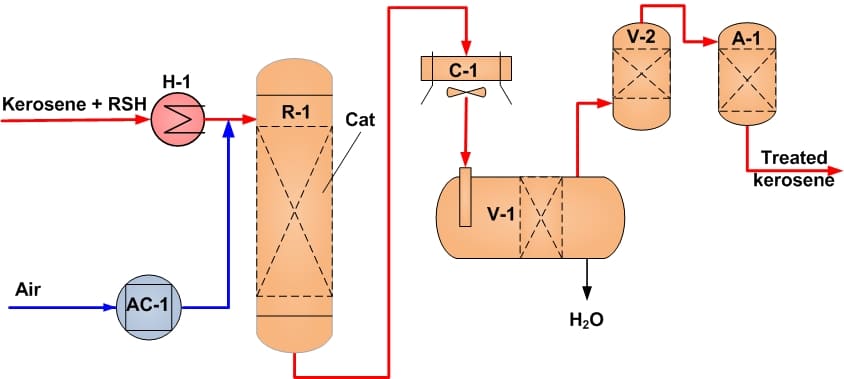
In the DMD-1 process, the kerosene feed is preheated and mixed with air before entering a fixed-bed reactor containing the IVKAZ catalyst.
Inside the reactor, mercaptans are converted into organic disulfides. After removal of water, residual moisture, and resinous compounds, a treated product with improved quality is obtained.
DMD-1 Process Performance and Results
One of the main advantages of this technology is its ability to significantly reduce mercaptan sulfur.
Based on process data:
| Feed | Result |
|---|---|
| Kerosene | Mercaptan sulfur reduced to below 20 ppm |
| Diesel fuel | Improved product quality and reduced mercaptan content |
Industrial Operating Experience of the DMD-1 Process
The DMD-1 process has been applied on an industrial scale for the treatment of aviation kerosene.
Industrial references include:
Kuibyshev Refinery, Russia: Reported unit capacity of 310,000 tonnes per year
Ukhta Refinery, Russia: Reported unit capacity of 50,000 tonnes per year
These industrial references demonstrate the applicability of the DMD-1 technology for the demercaptanization of middle-distillate refinery products.
IVKAZ Catalyst in Desulfurization Processes
IVKAZ is a highly efficient modified phthalocyanine catalyst developed for a wide range of sweetening and desulfurization processes.
It can be used as an alternative to phthalocyanine catalysts employed in technologies such as:
Merox WS
ARI-100-EXL
Applications of IVKAZ Catalyst
IVKAZ catalyst can be applied in the following areas:
Crude Oil and Gas Condensate Treatment
For the removal of:
Hydrogen sulfide (H₂S)
Mercaptans
LPG Treatment
For reducing sulfur compounds in liquefied petroleum gases.
Gasoline Treatment
Including:
Straight-run gasoline
FCC gasoline
within the boiling range of 62–180°C.
Light Hydrocarbon Fraction Treatment
For the removal of H₂S and light mercaptans.
Alkaline Wastewater Treatment
For the oxidation of sulfur compounds and regeneration of spent caustic.
Conclusion
The DMD-1 process is an effective technology for the demercaptanization of kerosene and diesel fuel. By using IVKAZ catalyst supported on activated carbon, the process enables the conversion of mercaptans into stable disulfides.
With suitable operating conditions, proven industrial experience, and applicability in refinery units, DMD-1 represents a specialized solution for improving the quality of middle-distillate products.
AAprolab
AAprolab manufactures IVKAZ catalyst and provides IVKAZ-based technologies, offering advanced desulfurization and sweetening solutions for the refining, petrochemical, and gas-processing industries.